

ABOUT ME
My name is Orsolya Vaktor. I am a writer, director, producer, and creator of story universes, best known as the creator of the seven-part Crystallight Saga and the wider creative universe that continues to unfold through interconnected stories of its own. My work explores the layers of human identity, transcendent remembrance, and the deeper dimensions of existence that lie beyond visible reality, bringing together the languages of literature and cinema within a storyworld that transcends borders and genres.
MY MISSION
For me, art is transcendence: a passage between the visible and the invisible, the known and the unknown, the external world and the inner realms of human experience. I believe that a work of art can transcend its own form and bring us closer to who we truly are beyond the roles we inhabit, the stories we construct, and the identities we build.
As an artist, I explore the deeper layers of human existence: the nature of identity and transformation, transcendent remembrance, and those liminal spaces where different realities and modes of perception converge. I do not seek to offer definitive answers, but to create stories and worlds that open new perspectives, awaken questions, and invite the audience to look beyond the narrative itself—to reflect more deeply on their own existence, their identity, and the nature of reality.
I believe that art has the power both to create an experience and to expand the space in which we contemplate ourselves and the world around us. For me, a story truly comes alive when it does not end with its final sentence or final frame, but continues to resonate within the person who has encountered it—revealing new connections, awakening curiosity, and opening pathways towards territories of thought that may previously have existed beyond the boundaries of their perception.
Literature and cinema, therefore, are not separate artistic forms to me, but different languages of the same creative consciousness. I believe in the permeability of artistic forms: that the same idea, emotion, or inner experience can find a different expression through a story, an image, a piece of music, or a film—and that each new form has the power to reveal another layer of its meaning.
I seek to create story universes that transcend genres, media, and cultural boundaries, while returning, from different perspectives, to the fundamental questions of human existence. For me, this is where creative freedom and the transcendent nature of art reside: in building bridges between worlds, ideas, and modes of perception, and in opening, with every story, another doorway towards what begins beyond the boundaries of known reality.
THE WORLD OF CRYSTALLIGHT SAGA
The Crystallight Saga explores the metaphysical layers of human existence. At the heart of its stories lies identity: the personality we construct within this lifetime, and everything that shapes us at a deeper level, within our subconscious, our memory, and our soul. How much do we truly know about who we are? Why do we experience certain circumstances in our lives, why do similar patterns repeat themselves, and why are there people to whom we feel bound by an inexplicably powerful sense of love, attraction, fear, or resistance?
In the world of the Saga, human relationships therefore never begin solely in the present. Behind the characters’ encounters lie experiences from previous lives, unresolved conflicts, emotional bonds, and karmic connections that unconsciously influence how they perceive themselves and one another, the choices they make, whom they allow close to them, and what they try to escape. Through transcendent remembrance, these deeper layers gradually become accessible, and the characters are compelled to confront the possibility that their present identity may be only one part of who they truly are.
One of the most powerful human expressions of this idea is the relationship between Mark and Molly. Mark is a world-famous Hollywood actor whose life and personality have become intertwined with the public identity constructed by the film industry and the system surrounding him; Molly, by contrast, lives an ordinary life far removed from that world. When they begin to remember one another on a transcendent level, they are forced to confront not only the meaning of their connection, but their own identities as well: Mark must face the question of who remains beneath his roles and the image created around him, while Molly must confront whether she is capable of leaving the safety of the life she has known and stepping into a reality that fundamentally changes everything she believed about herself.
The story, however, is not exclusively about the two of them. The characters surrounding them form their own network of relationships and remembrance, each carrying a different past, karmic bonds, and stories waiting to be resolved. A relationship may therefore take the form of love, friendship, a family bond, an alliance, or a conflict, while on a deeper level remaining part of the same process: an opportunity for something left unfinished in the past to be recognised and transformed in the present.
In this world, karma is neither punishment nor an immutable fate, but a deeper system of cause and consequence. Whatever a person has not yet understood, resolved, or transcended may reappear through new circumstances and relationships. With recognition, however, comes the possibility of choice. When a character no longer unconsciously repeats the same pattern but becomes capable of choosing differently, the past can gradually lose its power over the present, opening the way to dharma: the possibility of living a life that increasingly arises from one’s own deeper nature.
From this emerges one of the Saga’s most important questions: where does the boundary between fate and free will lie? Are there encounters, experiences, and turning points that are already part of the path with which we are born, while it nevertheless remains our choice what we do with them? What does fatum mean if not everything is predetermined—and what does freedom mean if our choices are influenced by subconscious layers whose very existence may remain unknown to us for much of our lives?
The Crystallight Saga explores these questions not as a theoretical system, but through human lives and destinies. Through love and loss, family relationships, power, fear, desire, choices, and new beginnings, it reveals how the conscious and the subconscious, personality and deeper identity, karma and dharma, fate and free will encounter one another.
Because perhaps our lives are shaped not only by what happens to us, but also by how much we are able to recognise of what we have carried with us—and by what we choose when, at last, we begin to remember.
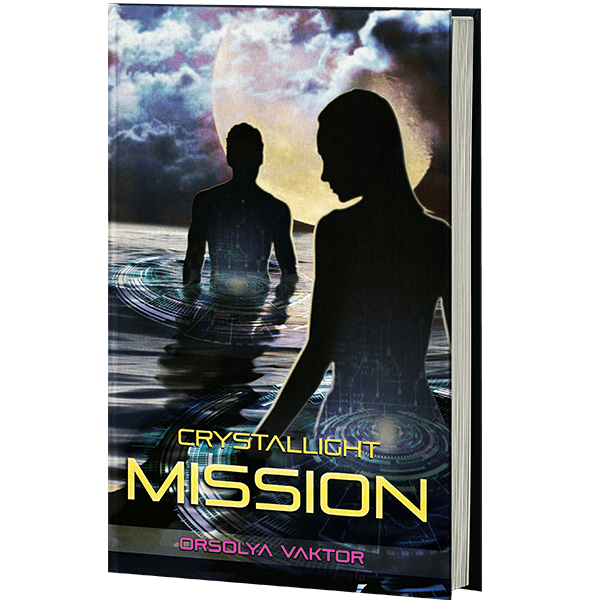
In the volume entitled Mission, which is Part I of Crystallight Saga, Matt and Izael arrive into the circle of life on Earth with a mission, as polarities and male and female manifestations of One Soul.
They are dual pairs of one another, like twin flame.
They intend to resolve karmic burdens brought from other worlds and a bygone past in the mystery of the primal consciousness and the primal power of love, so that in the course of the great turn of human ascension, they themselves can experience this twist of fate.
The protagonists of Crystallight Saga, Matt and Izael open up for us the charmic nexus system of existence and rebirth, according to which, although time and space may change, as members of a greater unity, all the actors accompany the others from one life to another.
What makes it possible that they find one another in every new world?
Do they dare to follow the signs that lead them to their mission?
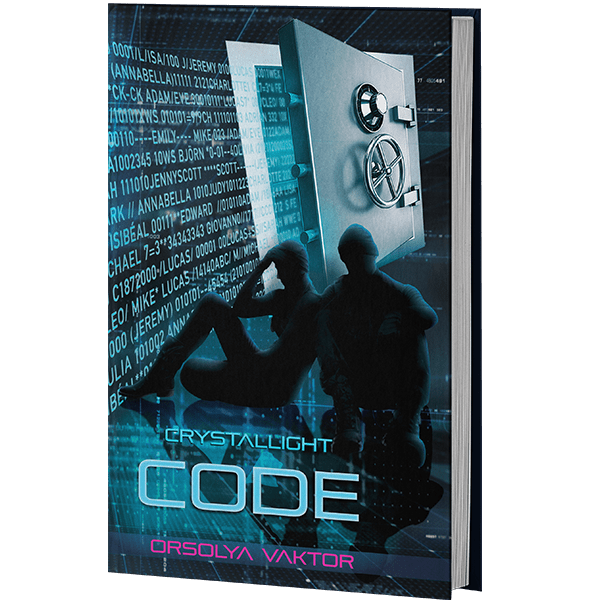
After the successful Part I of Crystallight Saga named Mission, Part II entitled Code continues with the story of the mission of Matt and Izael, in our present, who are reborn as Mark and Molly. What signs and codes have they built into their own fates that would lead them to one another? Who are those helpers to reoccur in their new lives or emerge as new actors, who will wake their memory?
Mark and Molly are the twin flame soulmates, who have to face the same hesitations as we all, actors of our everyday lives do. They are occupied by the same questions as us: What is universal elevation? How may one find their mission? While Mission revealed the charmic connections of previous lives, Part II, Code explores the reminders of present life and their corresponding faith and trust hidden behind the veil of oblivion through that very human bridge of doubt to be found in the fallibility of Molly and Mark.
Do we dare to believe, and take the path of the irrational? Do we dare to remember? Are Mark and Molly capable of realizing and decoding the signs encrypted in their previous lives?
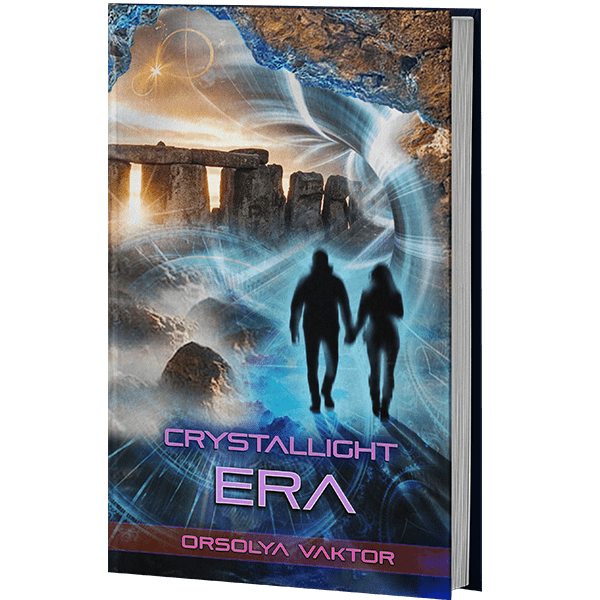
In Part III of the Crystallight Saga, Era, the One Soulmate twin flame love story of Mark and Molly continues from the male perspective. Through Mark’s spiritual journey, cosmic fate opens up, that Mark and Molly have inherited galactically into the goblet of their human existence from the history of other stars. The world of parallel star dimensions unveils, unfolding the spiral energy curve of space and time, the nature of duality, dymanics and the complementary quality of the poles Yin and Yang. One may encounter a deeper understanding of the primal love mystery of dual pairs.
After Part I (Mission) and the reincarnational cycle of the primal pair of soul, and Part II (Code) dealing with the mystics of telepathic communication and soul connections among twin flames, Part III (Era) reveals the multidimensional nature of our human existence, male and female energy, the possible paths of elevation of the power of love, as well as the cosmic importance of the energetic work of One Soul pairs within the present quantum field of our current paradigm change.
Our present-day society is at the brink of a change of era, just as Mark and Molly, who also live in the present-day 21st century. But what does that change of era or paradigmatic change imply? What is changing actually?
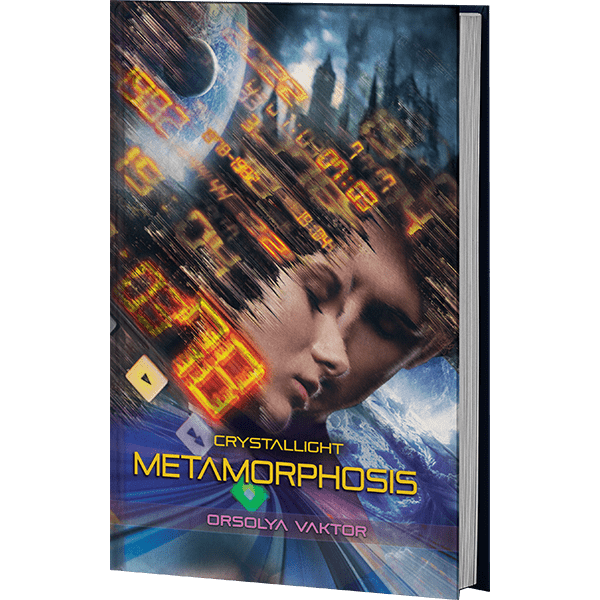
Part IV of Chrystallight Saga, Metamorphosis deals with deep philosophical and psychological questions through the adventures of its characters, and it presents the functioning and the dynamic natures of the dual poles of our world; the male and female qualities, as well as the complementary characteristics of the two phenomena, light and shadow, which affect human relations and situations in our lives. Since the beginning of time, mankind has been seeking answers to questions to such philosophical matters as where we come from, why we are here and what our goal is in this world.
Metamorphosis itself means transformation or transubstantiation; the process of of Unio Mystica. Part IV of the book series goes deeper in exploring the cosmic nexus of the initiational path of the twin flame mission, and thus it intends to shed light on the miracle of the awakening of the soul.
I wish you a glamorous journey of the soul!
We are all multidimensional creatures, who live in various dimensional streams at once, and such worlds rotate in accordance with one another and have an effect on the others as well.
The Metaphysical Questions of the Crystallight Saga
Who are we truly, beyond our present personality and the identity we have constructed?
What do we carry with us from our previous existences, and how do these unconscious memories shape our present lives and relationships?
Why do we encounter precisely those people who awaken the most powerful feelings of love, attraction, fear, or resistance within us?
How can the recurring patterns of karma be transformed through recognition and resolution, and how can our dharma unfold through this process?
Where does the boundary lie between predetermined destiny, fatum, and free will—and what do we choose when we recognise everything that, until then, had been unconsciously directing our lives?

MY STORY
I began writing as a teenager, when the loss of my grandparents brought me face to face with death for the first time. I found it difficult to accept that the people I loved could simply disappear from my life, and I tried to give form, through poetry, to the absence they had left within me. At first, I was preoccupied with life and mortality; later, with the arrival of first loves, entirely different layers of human emotion and relationships moved to the centre of my attention. As a young adult, short stories joined poetry, and although I was not yet consciously pursuing a literary career, it became increasingly natural for me to express, through words and stories, whatever touched me deeply on an emotional level.
My life did not initially lead me towards the arts. My family envisioned a more secure future for me, and I studied law and economics, with marketing being the area that interested me most within the latter. And although for a long time I felt that this belonged to an entirely different path, I no longer regard it as an unnecessary detour. I am drawn to systems, connections and analytical thought. Perhaps I was simply too idealistic, and too curious, to believe exclusively in what can be explained through reason.
Because throughout it all, I had always felt a profound attraction to the transcendent.
From a young age, I read about karma and reincarnation; later, I became increasingly interested in the workings of the subconscious and the invisible layers of human personality. I was not searching for ready-made answers. What fascinated me far more was why we are who we are; where the feelings, attractions, fears and connections inscribed so deeply within us originate; and how much we perceive at all of what is truly taking place in the deepest parts of ourselves.
The next major turning point came with motherhood. From the birth of my children onwards, I wanted to understand not only how I could be a good mother, but also who these souls were who had chosen me to accompany them through the first stage of their lives. Had we met before, in other lifetimes? Why had we come to one another in particular? What had they brought with them—what experiences, abilities and tasks—and what could I contribute to all that they had been born to experience and fulfil? From the very beginning, I saw in them not only my children, but independent spiritual beings who had arrived with their own personalities, gifts and individual paths. Increasingly, I found myself asking how I could raise them in such a way that, while giving them security, values and points of reference for this life, we would not obscure what they had brought with them from somewhere deeper. How could I help them not only to unfold into their personalities, but also to remain connected to their own souls and, in time, to recognise what it is they wish to experience and pass on through this life?
Motherhood inspired me to venture far more deeply into the study of metaphysical and transcendent perspectives than my previous interest had ever taken me. I began to study, worked with different methods, and accumulated an increasing number of personal experiences that transformed what I had previously known from books into something that was no longer merely theoretical for me. Through this inner work, what I now call transcendent remembrance gradually began to open within me: more and more images, emotions, stories and connections became accessible to me. Later, I began teaching as well, while all of this fundamentally transformed my creative work.
It is difficult to explain precisely how a story comes into being within me, because I do not write by first constructing, rationally, what is going to happen.
I see my characters; I see the settings and the movements; I hear the dialogue; I feel what they are experiencing—they shape the story, and I write it down. Sometimes a single scene arrives first; at other times, an entire narrative thread begins to unfold within me. There is intuition in it, emotion, and a distinctive kind of inner certainty. It is as though the world I will later give words to must first become real within me.
For a long time, literature was the natural form for this. Yet, after a while, I became increasingly interested in how I might carry further what I see inwardly while I write. How does an inner image become a sentence—and then, from that sentence, become an image once again? How can an emotion be not only described, but shown? What can a glance, an actor’s presence, light, space, silence, or music add to it?
This is what led me towards filmmaking. I began studying screenwriting, directing and filmmaking, and went on to make my first short film. At the same time, it became increasingly clear to me that, as a creator, I did not want to confine myself to a single artistic form.
Literature remains the art form closest to me, while film has opened a new dimension within me; and yet music and painting inspire me just as deeply. Increasingly, I find myself exploring how these different artistic languages can meet, extend one another’s possibilities, or reveal different layers of the same human experience.
For me, the common ground is transcendence.
This is the intellectual and emotional territory to which I return again and again: the visible and hidden layers of identity, the subconscious, transcendent remembrance, the deeper dynamics of human relationships and different situations in life, transformation, and everything within ourselves that we have yet to discover. Through different stories, different characters and different artistic forms—but, in truth, this is always what fascinates me.
I no longer feel the need to decide whether my rational or intuitive self is the “real” one. The same woman who studied law and economics wrote poetry as a teenager; later began exploring the nature of the soul, wrote novels and taught about transcendence; and eventually turned towards film. For a long time, perhaps, these seemed like separate paths. Today, I see that each of them has contributed something to the way I think, both as a human being and as an artist.
And perhaps this is the one thing I truly want from my art: not to tell others what to think, but to reach deeply enough for something within them to begin to move.
A feeling, a recognition, a question.
Something they will then carry forward themselves.