
TRANSMEDIA STORY UNIVERSE

I’m Orsolya Vaktor, a writer, director, producer and IP creator, and the creator of the Crystallight Saga — a creator-owned IP conceived as an expansive transmedia story universe with long-term development potential.
I do not simply write stories. I am interested in what happens to a human being when the reality in which they have, until then, been able to locate themselves with a sense of certainty begins to fracture. When a relationship, a transcendent memory, a loss, or an inexplicable recognition compels them to ask: am I truly who I have always believed myself to be?
As a creator, I am drawn to the layered nature of identity, ancient memory, the deeper structures of human relationships, free will, and the consequences of our choices. I am particularly interested in those situations in which two truths can exist simultaneously: what a person rationally knows about themselves and what they recognise within themselves with unquestionable certainty; what the outside world accepts as reality and what they themselves experience on a transcendent level; the life they have built and the life they would have to choose if they could no longer deny what they have recognised.
For me, a story becomes truly compelling at the point where transcendent recognition comes at a price.
This is also the dramatic foundation of the Crystallight Saga. I did not create it as a sequence of novels, but as an interconnected story universe unfolding across multiple volumes, in which human destinies, historical eras and cultures are woven together. The same fundamental conflicts return under different circumstances, within different social structures, and through different human choices. My characters are defined not by what they know about how the world works, but by what they do with what they have recognised – and what they may lose because of it.
For this reason, the metaphysical dimension is never, for me, an escape from reality. Quite the opposite: it is a means of moving closer to profoundly human conflicts. To love and fear. Power and vulnerability. Loyalty and betrayal. Social roles that offer security while also having the power to hold us captive. To the moment when someone must choose between the image the world has formed of them and their own truth.
My characters are therefore never illustrations of an idea. They make mistakes, they are afraid, they cling to what they know, they run, they manipulate, they love, they lose people and, at times, they lose themselves. In my stories, it is not recognition itself that changes their lives, but the decision they make afterwards – or the decision they do not dare to make.
As a writer, I build worlds; as a director, I explore how those worlds can be transformed into human presence.
This is why I have always thought about my stories visually as well. I am interested in a look that contradicts what a character says. The silence after a conversation. A space that reveals more about someone than exposition ever could. The way the meaning of the same scene changes depending on what the audience already knows and what the character has yet to discover. For me, the power of film often lies precisely in what we choose not to explain.
I therefore regard the Crystallight Saga as creator-owned IP and a transmedia story universe. The novels created to date are not simply stories available for adaptation, but an already established narrative world: recurring characters and conflicts, interconnected storylines, its own mythology, different historical eras, and long-form dramatic arcs capable of providing the foundation for multiple film and television formats.
As a producer, I think in terms of the long-term development of this world. As a director, I am interested in how all of this can be shaped into a distinctive audiovisual language – one that does not explain the ideas behind the story, but allows them to be experienced.
Because ultimately, what interests me is not whether there might be more than what we call reality.
What interests me is what happens to a human being once they experience that there is – and can no longer live as though they did not know it.
CRYSTALLIGHT SAGA – A STORY UNIVERSE ACROSS LIFETIMES
The name Crystallight originates from the central ontological metaphor of the universe: the alchemical process through which memory, experience, and conscious choice gradually reorganize human identity—just as the inner structure of matter rearranges itself into crystal.
What if a human life is not a self-contained, finite arc, but merely a single chapter within a far greater existence?
And what happens when we begin to remember who we were before we became the people we know ourselves to be today?
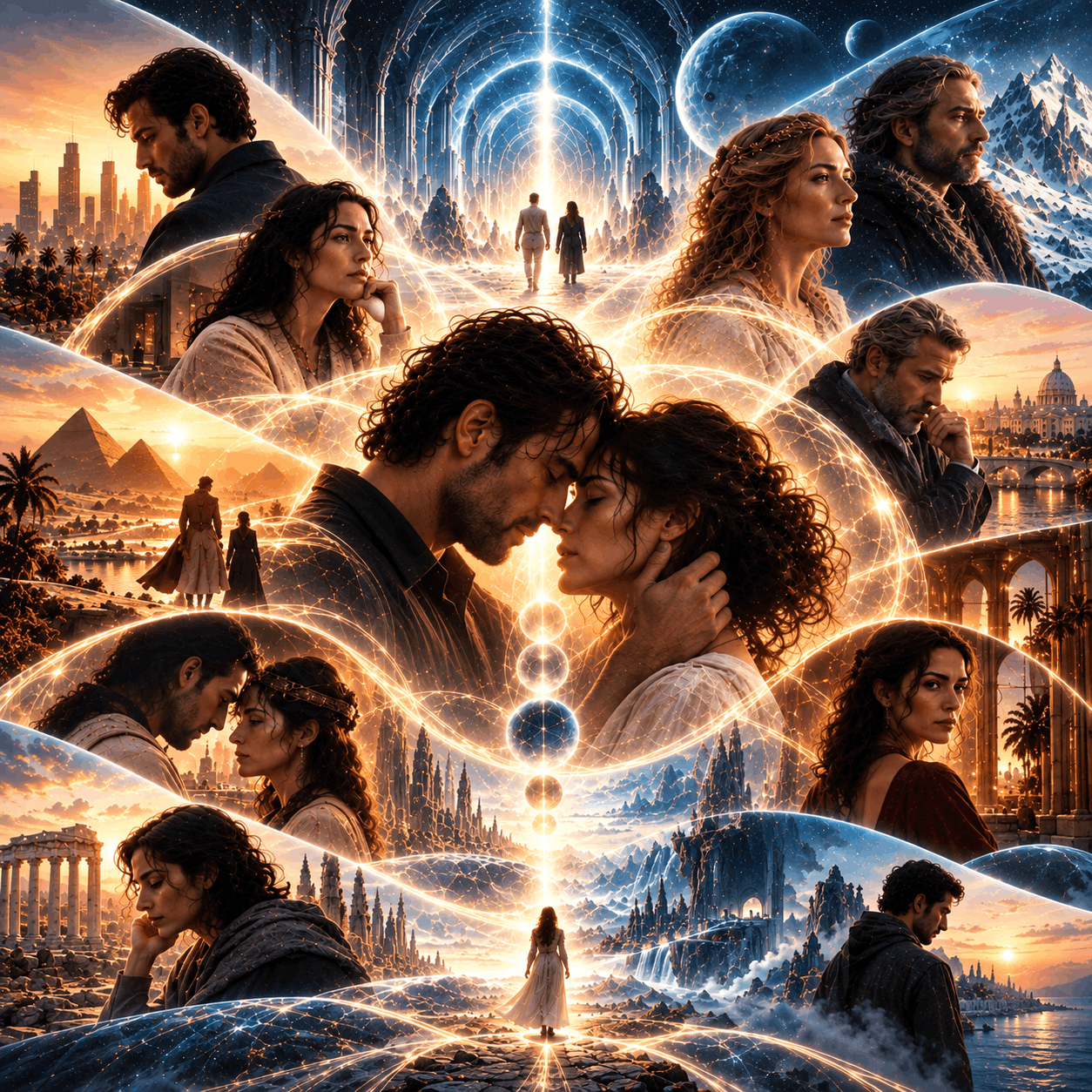
The Crystallight Saga is a narrative universe spanning lifetimes, eras, and civilizations, exploring human existence not within the closed system of a single incarnation, but as part of a longer ontological process. In this world, encounters have histories, losses have consequences, and relationships may have deeper origins that human consciousness no longer remembers. The echo of a single decision can reach beyond one lifetime, while an individual, under new circumstances, with a different identity and within a different web of relationships, may once again find themselves facing the very same task.
At its centre are Mark and Molly—two people in the present-day world whose connection is extraordinary not because they fall in love, but because they gradually come to realise that what exists between them did not begin in this lifetime.
But remembrance is not a gift without consequences.
Because when someone recognises in another person someone they have known in another life, everything they have built within their present existence does not simply disappear. Their attachments, responsibilities, social roles, fears, and the people whose destinies are intertwined with their own do not cease to exist. On the contrary: at the moment of recognition, two realities come into conflict.
What the soul remembers, and what human life demands.
As a world-famous Hollywood actor, Mark pays the price of living in a world that no longer sees the man, but the image constructed around him. The relentless pressure to conform, public judgement, and the character assassination mounted against him gradually erode Mark’s sense of identity: he becomes a stranger within the life he himself has built. When he recognises in Molly the woman to whom he has been connected across lifetimes, this ancient remembrance becomes both a certainty and a threat. Mark knows exactly what the world that appropriated his identity, reinterpreted it, and ultimately turned it against him is capable of, and he is therefore determined to keep Molly away from that world at any cost. The man’s paradox lies precisely here: while Molly represents his strongest connection to the identity he has lost, Mark fears that by allowing her close to him, he will expose her to the same destructive system within which he himself has slowly lost who he is.
Molly’s conflict is different in nature, but no less profound. Her challenge is not primarily to recognise what exists between them, but to endure the consequences of that recognition. After the losses and wounds of her own past, she is no longer willing to love at the cost of abandoning herself. While she remembers the unity that connects them on another plane of existence, in this life she must establish boundaries. She must learn to distinguish between recognising destiny and surrendering herself in its name. Her question, therefore, is not simply whether she can move closer to Mark, but whether she can remain faithful to an ancient memory while remaining faithful to herself.
It is at this point that their relationship becomes both a love story and an ontological conflict.
Because if the connection between two people truly continues across lifetimes, what does free will mean? Can there be a destiny chosen in advance without diminishing the significance of human choice? Is karma an inevitable repetition, or the possibility that one day we may choose differently? Is dharma a predetermined path, or a life purpose that can only be fulfilled if a person chooses it freely?
In the world of Crystallight, destiny is therefore not fate.
A life path carries possibilities, encounters, and chosen tasks, but in every incarnation, a person must decide anew what to do with them. Ancient memory does not absolve us of responsibility in the present. On the contrary: the more one remembers, the greater one’s responsibility for how one chooses.
Nor do Mark and Molly exist in a vacuum. Their decisions affect the destinies of others. They are surrounded by a complex web of loves, marriages, families, friendships, power dynamics, and previous choices. No one shapes only the course of their own life: each person simultaneously carries their own karma, participates in the unfolding destinies of others, and helps shape the reality they create together.
The metaphysical dimension of the Saga renders this invisible system of interconnections perceptible.
Elysium, the memory of the soul, the different incarnations, and the interwoven paths of multiple lives do not constitute a fantastical plane separate from human reality. They reveal a broader perspective on the same existence. The earthly characters are able to perceive only part of their own lives; for the reader, however, a larger structure gradually emerges, within which their encounters, fears, recurring conflicts, and choices acquire new meaning.
Personal drama thus gradually becomes part of a larger ontological question.
Because Mark and Molly’s remembrance is ultimately not merely about whether two people are capable of recognising one another again.
The question is whether they can transcend the pattern they have recreated across lifetimes.
Can they choose differently instead of choosing from fear? Can they connect with one another without violating their own free will or that of others? Can they distinguish between possession and love, attachment and remembrance, fate and choice? And can they accept the consequences when what they recognise as true comes into conflict with everything the world has until then told them was true?
At this point, the stakes extend beyond their relationship.
Within the universe of the Crystallight Saga, humanity itself moves through cycles of ancient remembrance and forgetting. Civilizations rise and disappear, knowledge is lost and reborn, while humanity repeatedly confronts the same fundamental dilemma: can it truly evolve without remembering its own origins and the purpose of its existence?
Mark and Molly’s personal conflict is an imprint of this larger human dilemma. Their remembrance carries the possibility that human beings might not merely repeat their own past, but become conscious of it. That they might recognise the patterns they recreate through their relationships, generations, and civilizations—and, for the first time, truly be free to decide whether to continue them.
At this point, individual destiny and humanity’s collective evolution become intertwined. What begins as an intimate recognition between two people acquires meaning within a larger order: the capacity for ancient remembrance becomes the possibility that humanity might not merely repeat itself under new circumstances, but transcend the structures of fear and power that repeatedly lead it towards the same consequences.
In this sense, karma is not punishment, dharma is not a command, and one’s life purpose is not a predetermined script. All three lead back to the same question: what does a person do with the knowledge to which they gain access, and are they capable, through their own free will, of transcending what they once repeated as necessity?
Because in the world of Crystallight, the ultimate meaning of remembrance is not to reclaim the past.
It is to discover whether, with knowledge of the past, we are capable of choosing a different future.
And perhaps this is also the deepest question at the heart of the Saga: if a person truly begins to remember who they are, where they came from, and what role they chose to undertake within this existence—will they have the courage to live accordingly?
CRYSTALLIGHT SAGA ON SCREEN – ADAPTATION VISION
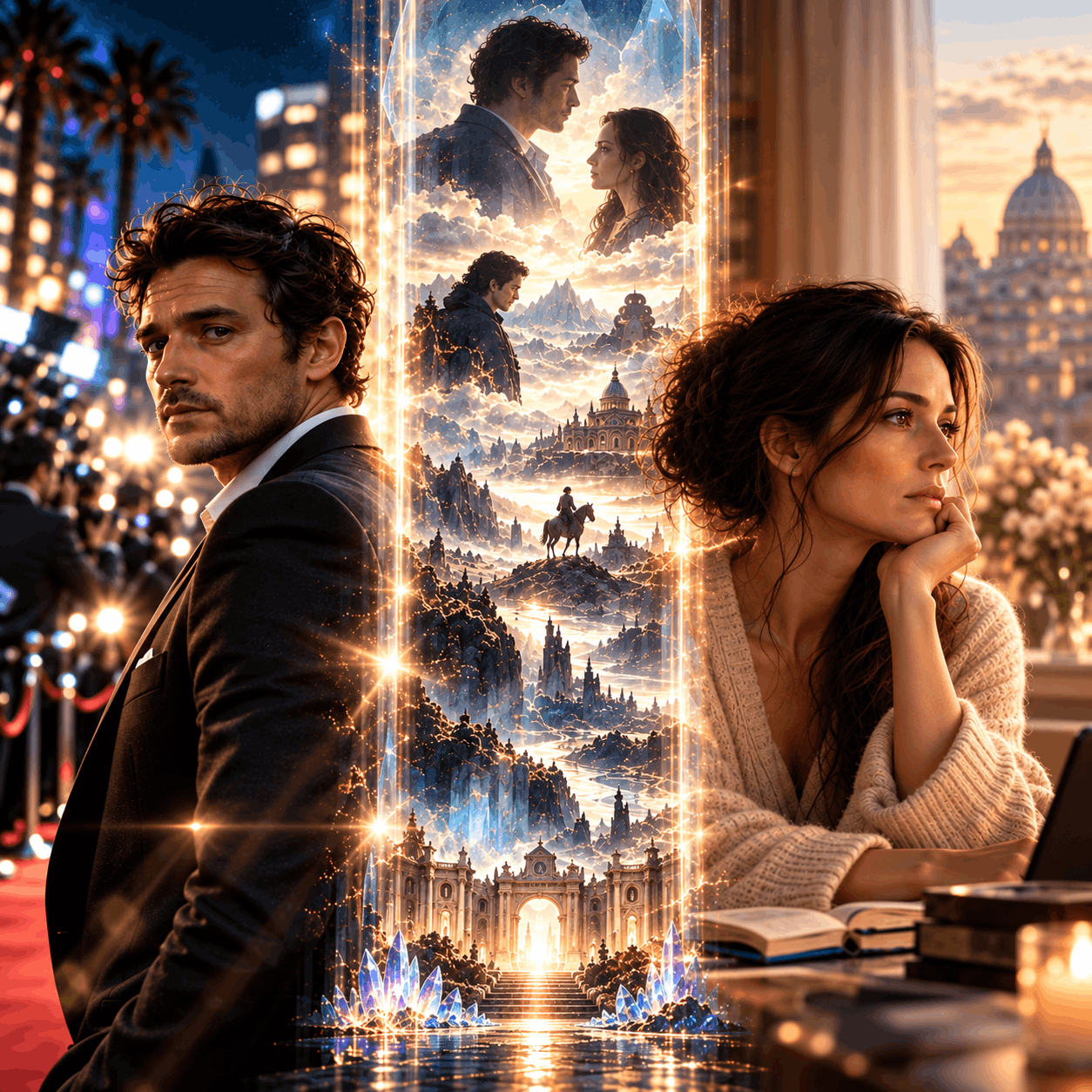
One of the greatest challenges in translating the Crystallight Saga into cinematic language lies in dissolving the linearity of time: within this universe, the past, the present, and memory spanning multiple lifetimes are not successive layers of time, but realities that exist simultaneously. The earthly reality of the present, incarnations lived across different eras and cultures, ancient civilizations, the transcendent realm of Elysium, and cosmic forms of existence are interpenetrating dimensions of the same existence.
The task of the screen adaptation is to create this ontological simultaneity: to make visible that what, from a human perspective, appears to be the past, a memory, or another world is, within a broader reality, present all at once.
The earthly plane of the present remains radically human. It is grounded in faces, gazes, bodies, silence, and words left unspoken. The true tension in Mark and Molly’s relationship often lies not in what they say to one another, but in what they have already recognised yet remain unable to articulate. The camera therefore does not explain the characters: it observes them. Subtext, silence, and inner conflict carry the same dramatic weight as dialogue itself.
From this intensely concrete human reality, the further layers of existence gradually begin to open.
I do not envision previous earthly lives as conventional flashbacks. The past does not interrupt the present; it breaks into its perception. A gesture, a touch, a gaze, a sound, or a space can open onto another era and another identity. Lives experienced across different historical periods and cultures therefore do not appear as self-contained episodes, but as overlapping imprints of the same existence. Behind a single face, multiple identities may become perceptible at once; behind a conflict in the present, a decision made in another era; and within a relationship, everything two people have already lived through together.
One of the most important challenges—and, at the same time, opportunities—of the screen adaptation lies precisely in the simultaneity of these planes of existence. I do not want to tell them one after another, but to allow them gradually to flow into one another. A moment in the present may open into another era; the memory of a previous identity may surface within a human gaze; the full meaning of an earthly decision may only become apparent on another plane of existence. Montage, sound, space, and the treatment of time thus become not merely formal devices, but part of the ontological structure of the universe itself.
Metaphysics, therefore, is not a visual element, but dramaturgy.
Transcendent experience invariably carries consequences within human reality. A recognition changes a relationship. A memory can overwrite an identity. A bond returning from another lifetime may come into conflict with the moral and social order of the present. The more layers of their own existence become accessible to the characters, the less capable they are of continuing unchanged within the life they had until then believed to be the only reality.
The visual concept therefore does not separate the psychological, historical, metaphysical, and cosmic dimensions. The visible world gradually becomes permeable. Different eras, lives, and planes of existence do not explain one another; they resonate with one another: the same fear may return in another body, the same choice in another era, the same relationship within another identity.
The viewer therefore does not observe the metaphysical system of this universe from the outside, but gradually enters its perceptual logic. First, the viewer begins to perceive connections, then questions their own interpretation, and ultimately confronts the same question as the characters: what if these are not separate worlds, but simultaneously existing layers of the same reality?
For me, this is precisely the most important cinematic possibility of adapting the Crystallight Saga: not to depict the transcendent, but to create an audiovisual language in which the boundaries between time, identity, and reality gradually become permeable—and through which the viewer, for a time, can experience the layered nature of existence themselves.
THE FIVE VOLUMES – THE UNFOLDING OF A SINGLE UNIVERSE
The five volumes of the Crystallight Saga created to date build a single, continuously expanding narrative architecture. Each novel opens a new perspective onto the same ontological system: from individual human destiny, through relationships spanning multiple lifetimes, the memory of ancient civilizations, and collective karma, to a universal order in which the origins, purpose, and consequences of human existence gradually become visible.
I. MISSION – THE ORIGIN
Mission introduces the question from which the entire Saga unfolds: what if human beings carry within themselves more than they are capable of remembering from their present lives? The boundaries of personal identity begin to dissolve, revealing the possibility of a greater origin. Behind human life, another order begins to emerge—one in which encounters, abilities, and chosen tasks can no longer be regarded as mere coincidence.
II. CODE – MEMORY
Code explores further the question of the ancient knowledge carried within the human being. Here, remembrance is no longer merely a personal past, but access to a deeper layer of information: the recognition that human consciousness may preserve imprints that extend beyond a single incarnation. The question is no longer whether the past exists within us, but what we do with it once it becomes accessible.
III. ERA – COLLECTIVE MEMORY
Era expands the individual perspective to the scale of civilization. Ancient cultures, different historical periods, and humanity’s recurring patterns become interconnected, while it grows increasingly clear that forgetting is not merely a personal phenomenon. Civilizations, too, can lose the memory of their own origins. Humanity may continue to repeat the same conflicts in new forms until it recognises the pattern it keeps recreating.
IV. METAMORPHOSIS – TRANSFORMATION
Metamorphosis is no longer merely about remembrance, but about its consequences. What happens when a recognition can no longer be reconciled with one’s former identity? A person is compelled to reinterpret themselves, their relationships, and their own place within a system greater than themselves. True metamorphosis does not occur when a person acquires new knowledge, but when they can no longer remain the same person they were before that recognition.
V. LEGEND – THE CHOICE
Legend distils the metaphysical, human, and civilizational layers of the previous volumes into a single dramatic question: what does a person do with what they have finally remembered?
In Mark and Molly’s relationship, ancient memory comes into direct conflict with the reality of their present lives. Recognition alone is no longer enough. They must choose between love and fear, chosen destiny and free will, social identity and inner certainty—while the consequences of their choices extend far beyond their own relationship.
The five volumes are therefore not five self-contained units, but five stages within a gradually unfolding system: origin – remembrance – collective recognition – transformation – choice.
This structure also provides the foundation for the adaptation potential of Crystallight. The already established character arcs, interconnected incarnations, historical periods, civilizations, and metaphysical planes of existence create a narrative foundation in which individual storylines can function as standalone cinematic works while remaining part of a larger transmedia IP universe capable of unfolding across multiple formats and over the long term.
ESTRANGED – EXPANDING A STORY UNIVERSE
The universe of the Crystallight Saga is not built exclusively around the story of Mark and Molly. Surrounding the central narrative arc are characters, relationships, and individual human lives whose own conflicts can further expand the universe and provide the foundation for standalone spin-off stories.
ESTRANGED is the first cinematic expression of this potential.
The short film presents a fragment of a spin-off story connected to the world of the Crystallight Saga. Rather than following the central storyline of Mark and Molly, it enters the same larger system of interconnections through the perspective of a supporting character. This shift in perspective allows different human experiences, conflicts, and questions within the same universe to come to the foreground, while the character’s individual trajectory gradually reconnects with the Saga’s broader narrative structure.
This structure represents one of the fundamental possibilities within the transmedia concept of the Crystallight Saga. The protagonists’ story forms a central axis, but it does not define the boundaries of the universe. The supporting characters do not merely constitute the dramatic environment surrounding the protagonists: they possess their own origins, memories, networks of relationships, and choices. Exploring the story of any one of these characters can reveal the same larger ontological system from a new perspective.
Within this framework, the Five Gates of Remembrance also acquire particular significance. The same fundamental questions—identity, origin, inherited patterns, connection, free will, and humanity’s place within an order greater than itself—can manifest through entirely different conflicts in the lives of different individuals. The universe is therefore not constructed around a single answer, but can explore the same existential question through multiple human lives, multiple perspectives, and multiple layers of experience.
ESTRANGED therefore serves a dual purpose on this page. On the one hand, it demonstrates how the Crystallight universe can generate independent narrative branches and spin-offs beyond its central storyline. On the other, it is a first audiovisual expression of the directorial and adaptation vision through which I imagine this universe on screen: character-driven, grounded in psychological realism, built upon the tension between what is spoken and what remains unspoken, while a broader system of interconnections gradually becomes perceptible behind the individual human drama.
ESTRANGED is not a condensed screen version of the story of the Crystallight Saga. It is a single doorway into the same larger universe—through the destiny of another human being.
CRYSTALLIGHT – THE METAPHOR OF TRANSFORMATION
The name Crystallight embodies one of the fundamental philosophical and ontological ideas of the Saga.
For me, the crystal is a metaphor for transformation. It represents a process in which the internal structure of matter gradually becomes ordered until a new quality emerges. Just as carbon, under the right conditions, can transform into diamond by forming a crystalline structure, human beings can also be transformed by everything they experience, lose, recognise, and ultimately integrate consciously into themselves over the course of their lives.
In this sense, Crystallight is neither an object nor a supernatural phenomenon, but a metaphor for the transformation of human consciousness.
Within the world of the Saga, human identity is not an immutable given. It is composed of layers: experience, memory, relationships, trauma, choices, and imprints whose origins may extend beyond a single human lifetime. Remembrance, therefore, is not simply a return to the past, but an alchemical process: recognising the scattered fragments, bringing them into relation with one another, and integrating them into a broader sense of identity.
“Light” represents the other side of this process. It is the moment of recognition when a connection becomes visible between experiences previously believed to be separate. A moment when a person does not simply know more about their own past, but begins to understand themselves, their own choices, and their place within existence differently.
Crystallisation thus becomes a psychological, metaphysical, and ontological concept at once.
And the same process can be understood not only on the level of the individual.
One of the broadest arcs of the Crystallight Saga explores whether humanity as a collective is capable of what the individual is capable of: recognising its own recurring patterns, recovering the lost layers of its memory, integrating the experiences of its past, and thereby transcending the structures of fear, power, and relationships that it recreates from one era to the next.
Crystallisation, therefore, does not mean becoming perfect. It means becoming conscious.
It does not mean that a person is freed from their own contradictions, but that they become capable of recognising them. It does not mean that they no longer make mistakes, but that they are no longer compelled to repeat the same ones. It does not mean fulfilling a predetermined destiny, but becoming capable of making choices within it with ever greater awareness.
In this sense, Crystallight is more than the name of the Saga.
It is the name of the transformation through which its characters, its civilizations, and ultimately humanity itself pass: from forgetting to remembrance, from fragmented identity to integration, from repetition to conscious choice.
CONTACT
The Crystallight Saga is an existing, continuously evolving, creator-owned IP and transmedia story universe whose five volumes, interconnected system of characters and incarnations, original mythology, spin-off potential, and established screen adaptation concept provide the foundation for long-term audiovisual development.
As a creator, writer, director, and producer, I am open to professional collaborations in which the further development of this universe for film and series formats, its international adaptation, and its long-term expansion can become the subject of a shared creative dialogue.
If you, too, can envision the film, the series, or the potential for an expanding world within this universe, I would be delighted to begin a professional conversation.
Vaktor Orsolya
Writer · Director · Producer · IP Creator